In the packaging and logistics industry, the integrity of shipping containers directly impacts product safety, supply chain efficiency, and brand reputation. When corrugated boxes are stacked during warehousing or transit, they must withstand significant compressive forces without collapsing or deforming. The Carton Compression Tester—also referred to as a Box Compression Tester, Carton Crush Strength Tester, or Corrugated Box Compression Testing Machine—is the precision instrument designed to measure exactly how much compressive force a packaging container can endure.
This article provides a comprehensive overview of the carton compression tester, covering its functions, applications, working principles, technical specifications, and the international standards it complies with.
A Carton Compression Tester is a laboratory testing machine specifically designed to measure the compressive strength, deformation characteristics, and stacking capability of packaging containers. By subjecting a carton to controlled compressive force until it deforms or collapses, the tester provides critical data that helps manufacturers determine whether their packaging can withstand the rigors of storage, stacking, and transportation.
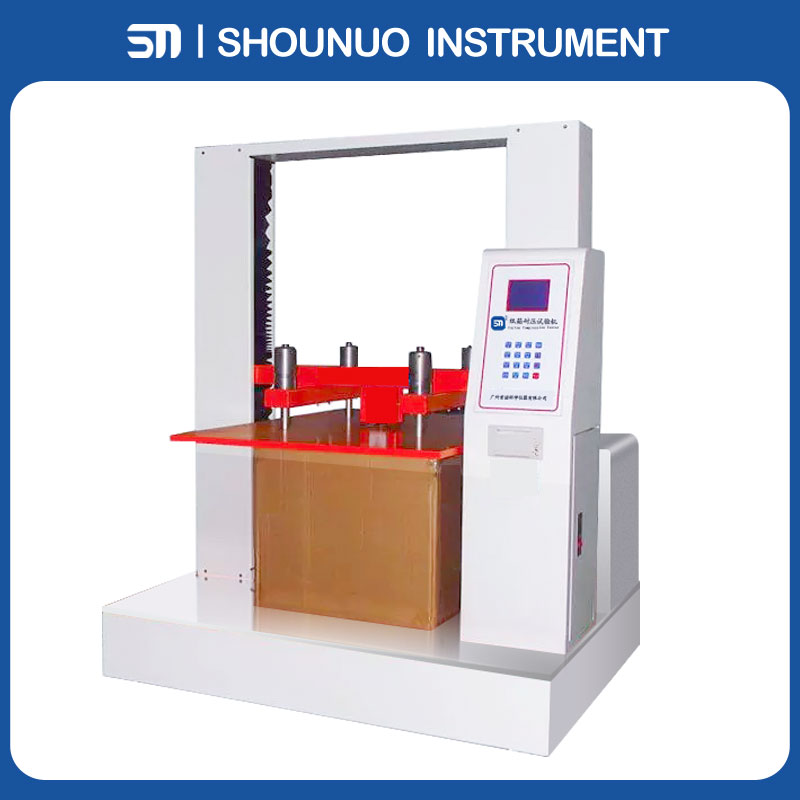
Take the SN-ZXE Carton Compression Tester as a representative example. This instrument is widely used to evaluate corrugated boxes, honeycomb boxes, paperboard containers, and other packaging materials. It can also be extended to test paper drums, paper cans, and other packaging forms.
Cardboard boxes are routinely stacked one on top of another during warehousing and shipping. Without adequate compression strength, the bottom boxes in a stack can collapse, leading to product damage, financial losses, and safety hazards. The carton compression test ensures that:
For manufacturers, the carton compression strength test serves as a reliable index of overall material quality and workmanship. It enables data-driven decisions in packaging design, material selection, and quality control.
The carton compression tester operates on a straightforward yet highly precise principle: applying a gradually increasing compressive force to a packaging container until it fails.
The machine consists of two parallel compression plates—a fixed lower plate and a movable upper plate. The test sample (the carton) is placed on the lower plate. The upper plate then moves downward at a controlled speed. As the force increases, high-precision load cells measure the resistance of the box in real time.
The test continues until one of the following occurs:
The system automatically records key parameters including maximum compression force, deformation amount, and the force-deformation curve.
Modern carton compression testers offer multiple testing modes to accommodate diverse packaging evaluation needs. The SN-ZXE model, for example, supports three primary testing modes:
1. Compression Strength Test (Box Crush Test)
Measures the maximum compressive force a carton can withstand before collapse. This is the most fundamental test for determining Box Compression Strength (BCT).
2. Constant Load Test (Stacking/Set Value Test)
Measures the deformation of a carton under a defined load, or alternatively, measures the load required to achieve a defined deformation.
3. Stacking Test (Creep Test)
Simulates long-term stacking conditions by applying a constant load to the carton over a specified period and monitoring deformation over time.
The carton compression tester is an essential quality control instrument across numerous industries. The SN-ZXE model, for instance, is widely applied in:
| Industry | Application |
| E-commerce & Retail | Ensuring shipping boxes withstand stacking during fulfillment and delivery |
| Food & Beverage | Testing cartons for perishable goods, beverages, and edible oil containers |
| Pharmaceuticals | Verifying medical product packaging remains intact during distribution |
| Logistics & Warehousing | Determining safe stacking heights and load capacities |
| Manufacturing | Quality control of corrugated and honeycomb boxes |
| Packaging Design | Optimizing material selection and box construction |
Beyond traditional corrugated boxes, the carton compression testing machine is also suitable for compression testing of paper drums, paper cans, and other packaging forms.
Carton compression testers are available in various configurations to accommodate different testing requirements. Below are the typical specifications for a professional-grade instrument like the SN-ZXE series:
| Parameter | Typical Range |
| Load Cell Capacity | 5 kN to 50 kN (optional) |
| Force Resolution | 1 N |
| Accuracy | ±1% of full scale |
| Deformation Resolution | 0.1 mm |
| Test Speed | 5–300 mm/min (adjustable) |
| Test Space (L×W×H) | 600×600 mm to 1500×1500 mm, height up to 1300 mm |
| Power Supply | 220VAC 50Hz / 120VAC 60Hz |
| Net Weight | 220 kg to 800 kg |
When selecting a carton compression tester for your laboratory or quality control department, look for the following advanced features. Professional instruments like the SN-ZXE series are equipped with:
To ensure test results are globally recognized and comparable, carton compression testers are manufactured to comply with major international and national standards. The SN-ZX series, for example, complies with:
Compliance with these standards ensures that test results are accepted internationally, facilitating global trade and quality assurance.
The Carton Compression Tester is an indispensable instrument for any business involved in packaging, logistics, or quality control. By accurately measuring the compressive strength, deformation characteristics, and stacking capability of corrugated boxes and other packaging containers, this testing machine helps manufacturers ensure product safety, optimize material usage, and comply with international quality standards.
Whether you are testing e-commerce shipping boxes, pharmaceutical packaging, or industrial containers, a reliable Box Compression Tester—also known as a Carton Crush Strength Tester or Corrugated Box Compression Testing Machine—provides the data you need to make informed packaging decisions and protect your products throughout their supply chain journey.
Previous article:ASTM D3985 Oxygen Transmission Rate Testers: OTR Testing Guide for Packaging
Next article:ASTM D882 Plastic Film Tensile Strength Tester
Back
Solvent Moisture Tester: Hidden Moisture Control for Flexible Packaging & Pharma Compliance
07.09.2026
Water Vapor Transmission Rate Tester: Stop Moisture Damage, Extend Shelf Life
31.08.2026
Coefficient of Friction Tester: The Complete Guide to COF Testing for Packaging, Food & Pharma
24.08.2026
Flexible Packaging Compression Testers: Strategic QA for Global Markets
17.08.2026


